

CAN, LIN, FlexRay, MOST Data Network Diagnostics & Repair
Modern vehicles are complex electronic systems where dozens of control units operate within a single data network.
CAN, LIN, FlexRay and MOST networks are responsible for communication between the engine, transmission, safety systems, comfort modules and multimedia systems.
If communication fails – the issue can affect the entire vehicle.
Szulc Motorsport – diagnostics, not guesswork.
Communication issues between control units?
Typical symptoms:
-
no CAN communication
-
gateway faults
-
limp mode with no clear cause
-
ABS / ESP / ADAS systems not working
-
gearbox issues without mechanical faults
-
no access to control modules
In many cases, this is not a failed component.
This is a data network problem.
CAN diagnostics – basic test
The first step is checking CAN bus resistance.
Measurement is performed at the OBD port (pins 6 and 14) with ignition OFF.
Results interpretation:
-
~60 Ω → network OK
-
~120 Ω → open circuit
-
0 Ω → short circuit
This is a quick and effective initial check.
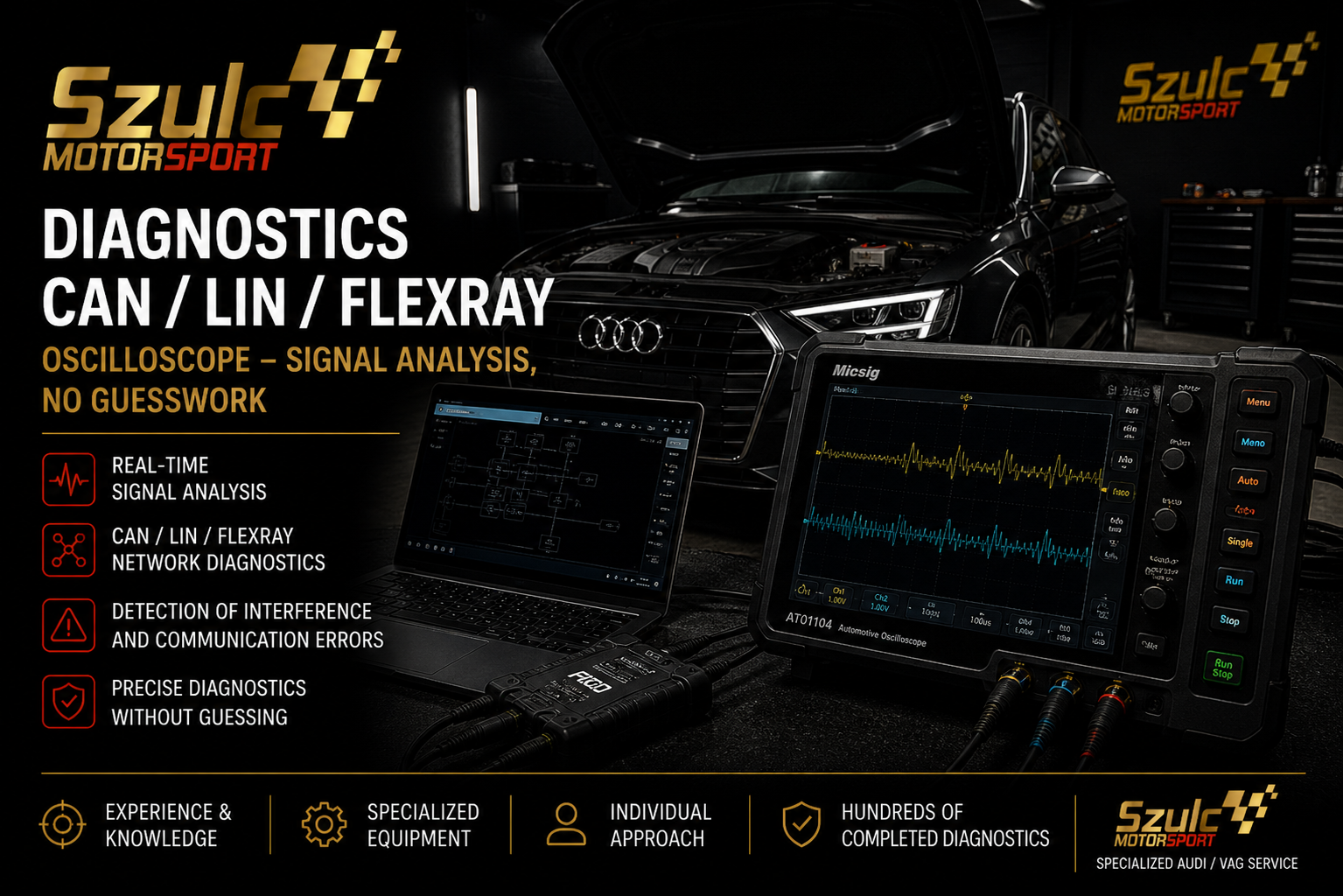
Advanced diagnostics – oscilloscope analysis
In real-world diagnostics, scan tools are not enough.
Oscilloscope analysis allows detection of:
-
signal disturbances
-
short circuits to ground or power
-
faulty control units blocking communication
-
transmission errors
Data rates:
-
CAN → up to 1 Mbit/s
-
FlexRay → up to 10 Mbit/s
-
MOST → up to 150 Mbit/s
Without signal analysis, many faults remain invisible.
CAN wiring repair – critical rules
Incorrect wiring repair leads to recurring faults.
Key principles:
-
maximum untwist length: ~50 mm
-
minimum distance between joints: ~100 mm
-
maintain proper twist of CAN High / CAN Low
Ignoring these rules causes signal distortion and communication errors.
Vehicle communication networks
Modern vehicles use multiple data systems:
-
CAN – main network
-
LIN – comfort systems
-
FlexRay – safety systems
-
MOST – multimedia
-
K-Line – legacy diagnostics
-
Ethernet – high-speed modern communication
Each requires a different diagnostic approach.
Most common CAN network issues
Typical real cases:
-
no CAN communication (Audi / VAG, BMW, Mercedes)
-
gateway errors
-
no communication with modules
-
random faults across multiple systems
-
limp mode without clear cause
-
ADAS system failures
In many cases, the root cause is the network itself, not the component.
When clients come to us
CAN diagnostics usually involves cases where standard diagnostics failed:
-
no communication despite seemingly good wiring
-
unexplained gateway faults
-
inability to connect to specific modules
-
intermittent communication errors
-
vehicle in limp mode with no mechanical issues
Most common causes of CAN failures
-
damaged wiring harnesses
-
short circuits or open circuits
-
faulty modules blocking communication
-
post-accident electrical damage
-
incorrect wiring repairs
-
retrofits and electrical modifications
That’s why proper diagnostics must be based on measurements and signal analysis, not fault codes alone.
Real-world diagnostics approach
Communication faults can:
-
affect multiple systems at once
-
be stored in a different module than the root cause
-
block full vehicle diagnostics
-
appear even when components are fully functional
Data analysis is key – not parts replacement.
Real cases
Typical scenarios:
-
damaged wiring after collision
-
control units blocking communication
-
faults after incorrect repairs
-
issues after electrical modifications
Each case requires an individual approach.
Scope
Primary focus:
-
Audi / VAG CAN diagnostics
Selected cases also handled for:
-
BMW
-
Mercedes
-
Porsche
Approach
-
diagnostics based on measurement and data analysis
-
no guessing
-
no unnecessary parts replacement
Szulc Motorsport – cases others failed to solve.